
How to Use Lemon Vibrators When Pleasure Feels Less Intense After Menopause
Let's be real. Menopause changes how pleasure feels. It doesn't kill it, but the sensations you relied on for decades can suddenly feel muted, diffuse, or weirdly hard to access. Your body isn't broken. Your clitoral nerves are still there. Your brain still wants this. What's changed is the tissue environment and how quickly your nervous system wakes up.
The good news? Lemon clitoral vibrators work better in a post-menopausal body, not worse. They're designed for this exact shift. Here's how to use them when pleasure feels less intense.
What's actually happening to sensation after menopause
Estrogen drops by roughly 90 percent. That single fact rewires everything about how your body responds to touch. The vulval tissue gets thinner and less elastic. The clitoral glans loses some of its plumpness. Blood flow to the genitals is slower. The pelvic floor muscles lose tone, which changes how sensations travel and concentrate.
But here's the thing people don't tell you: your clitoral nerve density doesn't change. Neither does your capacity for orgasm. What changes is the speed at which arousal builds and the type of stimulation that works best.
Many people report that once they adjust their approach, their most intense orgasms happen after menopause. This isn't magical thinking. It's neurophysiology. When you stop fighting what's changed and start working with it, pleasure intensifies.
Why lemon vibrators outperform other toys when sensation dips
Most vibrators rely on rapid vibration to trigger response. That works brilliantly on tissue with robust blood flow and elasticity. After menopause, rapid vibration can feel overstimulating without feeling satisfying. It's like knocking on a door that's slightly sealed.
Lemon vibrators work differently. The clitoral vibrator uses precision stimulation at the exact frequency your nerves need to build sensation gradually. It doesn't batter the tissue. It wakes it up methodically. Think of it less as a hammer and more as a tuning fork that finds the frequency your body is ready to respond to.
This matters because post-menopausal sensation needs time. Your nervous system isn't sluggish. It's just working on a different timeline. Lemon vibrators honor that timeline instead of fighting it.
Start with understanding your new arousal arc
Before you reach for any toy, you need a baseline. Spend a week or two noticing what's different.
How long does it take to feel something? If it used to take 5 minutes and now takes 15, that's your new normal. Don't interpret this as a problem. It's data. Once you know the timeline, you can work with it.
What type of touch registers first? Direct clitoral contact, or do you need broader pressure on the vulva first? Some people find that after menopause, the clitoris needs a warmup phase before it's ready for direct stimulation. Others find the opposite. Experiment without judgment.
Where does sensation live in your body? Some people report that post-menopausal pleasure is less centered on the clitoris and more diffuse across the vulva. Others find it's more concentrated than ever. Your body will tell you if you listen.
The lemon vibrator setup that works post-menopause
Here's the tactical part. When intensity feels lower, these adjustments make a measurable difference.
Build arousal first. Use lube early. Before you turn on your Lemon Toys clitoral vibrator, give yourself 10 to 15 minutes of manual exploration. This isn't wasted time. It's activation. Your nervous system needs the signal that pleasure is coming. Add a water-based lubricant generously. Post-menopausal tissue responds dramatically better with lube. It's not a sign something's wrong. It's the opposite. Lube helps your body do what it's supposed to do.
Start at a lower intensity setting. Lemon vibrators have multiple intensity levels for exactly this reason. Start at pattern 1 or 2 and stay there for 3 to 5 minutes. This gives your clitoral nerves time to recognize the sensation and amplify their response. Many people skip this step because they expect immediate intensity. That's the old arousal timeline talking. The new one is slower and, once you adjust to it, often more satisfying.
Hold the vibrator at an angle. Direct application to the clitoral glans can feel overwhelming or oddly numb post-menopause. Try angling the vibrator so it's stimulating the clitoral hood or the sides of the clitoris. This distributes sensation across more nerve endings and often feels more intense, paradoxically, than direct contact.
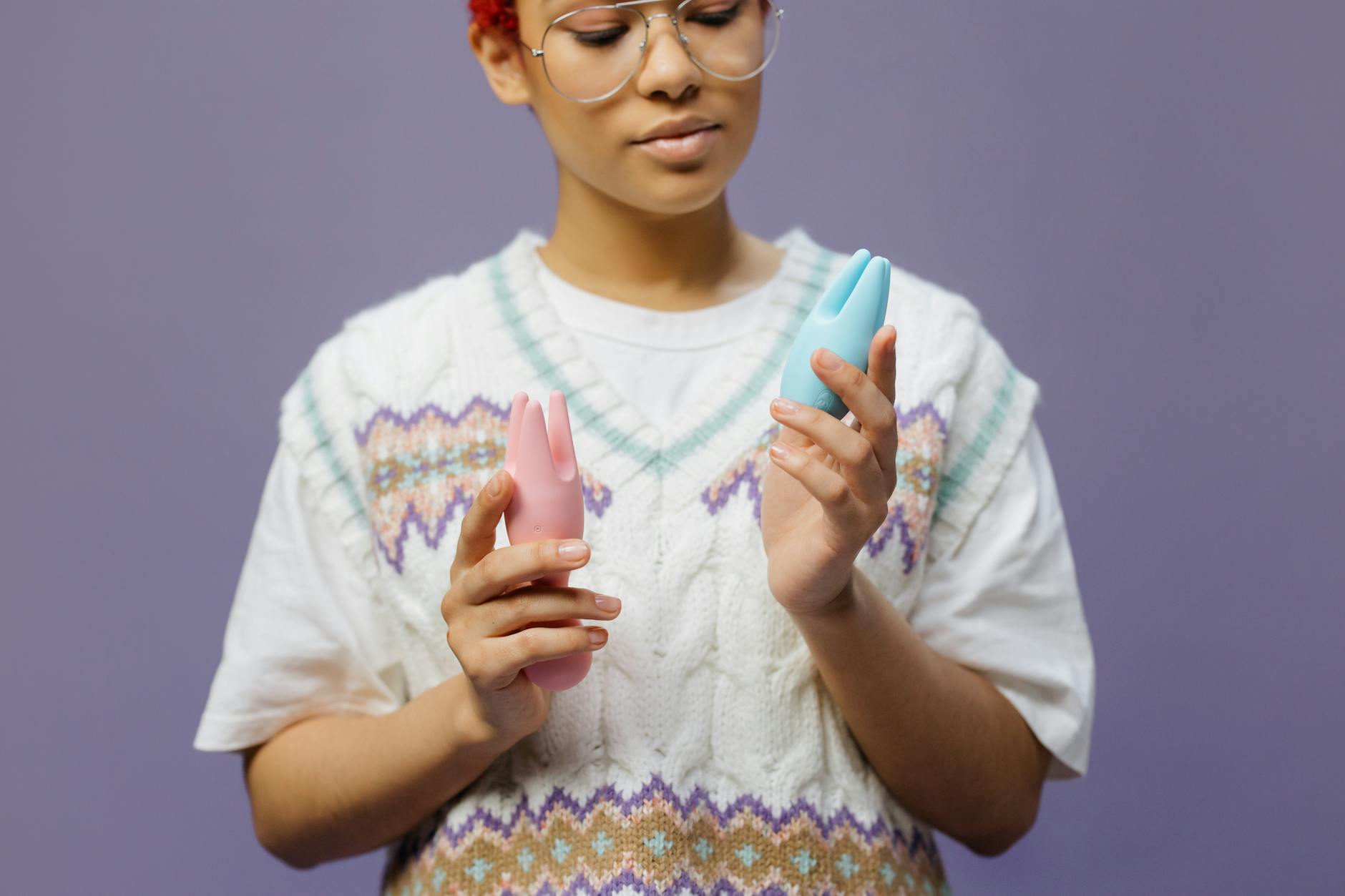
Photo by cottonbro studio on Pexels
The breathing technique that amplifies sensation
This is non-negotiable if pleasure feels flat. Your nervous system governs both breath and sensation. When your breath is shallow, sensation stays shallow.
As you're using your lemon vibrator, breathe deeply and slowly. Inhale for 4 counts, exhale for 4 counts. This does two things simultaneously. It lowers your nervous system's "threat detection," which is often elevated post-menopause and dampens pleasure. It also increases blood flow to your genitals, which directly amplifies sensation.
Practice this before you use the vibrator. Spend two minutes just breathing. Then add the toy. The combination is wildly more effective than the toy alone.
When to increase intensity gradually
Don't jump to higher settings hoping for faster results. This is the opposite of what works. After 5 to 7 minutes at a lower level, your body will tell you it's ready for a bump up. You'll notice the pleasure shifting from general to more focused. That's the signal to try pattern 3 or 4.
Many post-menopausal users find their sweet spot is actually lower than their pre-menopause setting. And their orgasms are more intense. This is the key insight: intensity isn't about the vibrator's power. It's about the match between the vibrator and your nervous system's current sensitivity.
The pelvic floor factor after menopause
Your pelvic floor is looser post-menopause. This changes how orgasms feel. Some people experience this as less intense. Others experience it as more diffuse and actually preferable. The key is understanding that the sensation will be different, and different doesn't mean worse.
If you want to concentrate sensation, gently engaging your pelvic floor muscles during orgasm can help. Squeeze the muscles you'd use to stop urination about 30 percent of max strength as you approach climax. This doesn't require complex Kegel work. Just a gentle engagement.
If you prefer the more diffuse sensation, skip this step entirely. Your body knows how to orgasm. Post-menopause, it's just expressing that knowledge differently.
Combining lemon vibrators with partner touch if that's part of your life
If you're using a lemon clitoral vibrator with a partner, communicate the new timeline. Tell them: "I need 15 minutes of buildup now, and I'm starting on a lower setting." This removes the pressure and guesswork.
Many couples find that post-menopausal pleasure is actually deeper because the pace is slower. There's more room for connection, more time to be present, more language around what's working. This is a feature, not a bug.
When to see a specialist
If pleasure hasn't returned after 4 to 6 weeks of consistent use with these adjustments, or if you're experiencing pain, talk to a menopause-informed gynecologist. Genitourinary syndrome of menopause (GSM) is highly treatable. Topical estrogen creams work rapidly and have minimal systemic absorption. This is not a Band-Aid. It's a legitimate medical intervention.
Similarly, if desire has completely vanished and isn't returning with time and attention, testosterone therapy is worth discussing with a provider who specializes in menopause care.
FAQ: Lemon Vibrators and Post-Menopause Pleasure
Why do lemon vibrators feel more intense for some people after menopause?
Lemon vibrators use a specific frequency and precision that aligns with post-menopausal nerve sensitivity. The clitoral tissue after menopause is thinner and more sensitive to vibration than pre-menopausal tissue. A vibrator that worked fine before menopause might feel too intense or not intense enough post-menopause. Lemon vibrators are engineered for sensitivity, so they deliver stimulus that matches this shifted sensitivity rather than fighting against it.
How long before I feel a difference using a lemon clitoral vibrator after menopause?
Most people report noticeable shifts within 2 to 3 weeks of consistent use with the techniques above. The first few sessions might feel muted because your body is recalibrating. By session 5 or 6, sensation usually sharpens. By week 3, many people report that orgasms feel as intense as ever, just arriving on a slower timeline.
Is using a lemon vibrator more often going to damage post-menopausal tissue?
No. Consistent, thoughtful use does not damage tissue. In fact, regular sexual stimulation improves blood flow to the genitals, which supports tissue health. The key is using appropriate intensity and listening to your body. If you feel soreness or irritation, dial back intensity and add more lube. Post-menopausal tissue is resilient when it's treated with the adjustments it needs.
Can I use a lemon vibrator if I'm on topical estrogen cream for menopause symptoms?
Absolutely. Topical estrogen actually makes lemon vibrators work better because it restores some tissue thickness and elasticity. Many people find that combining topical estrogen with a lemon clitoral vibrator creates a noticeable amplification. There's no interaction or contraindication. They work synergistically.
What if my partner wants faster results and isn't patient with the slower arousal timeline?
This is a relationship conversation, not a body problem. Share what you've learned about your post-menopausal arousal timeline. If a partner can't adjust, that's information about the relationship, not about you or your vibrator. Your pleasure deserves patience. Full stop.
Does using a lemon vibrator regularly mean I'll need higher intensities over time?
Not necessarily. Unlike some vibrators, lemon toys are designed so that consistent use doesn't create the numbing effect that requires escalating intensity. Many regular users find their intensity stays stable or even decreases over time because their body's sensitivity to the frequency stabilizes. Quality matters. A well-designed vibrator won't train your nerves to ignore it.
The bottom line
Menopause changes pleasure. It does not end it. Your most intense, most satisfying orgasms might actually be ahead of you, not behind you. The shift requires adjustment: slower timelines, different positioning, more attention to what works now. Lemon vibrators are specifically engineered for this season of your sexuality.
Your body isn't broken. You're not losing your sexuality. You're entering a phase where pleasure works differently, and once you stop fighting that difference, it often deepens. Start with patience, add lube and breathing, honor the slower timeline, and give yourself 3 to 4 weeks. Your pleasure matters. This matters.
If you want more guidance on navigating pleasure after major life changes, explore how lemon vibrators help rebuild intimacy after relationship gaps. For technical care questions, check our care guide.