
Let's start with the honest part
Different preferences don't mean incompatibility. They mean you're two separate people with two separate nervous systems. The assumption that a good partner relationship means wanting exactly the same thing is one of the loneliest myths we carry into bed.
I've worked with hundreds of couples, and the ones who thrive aren't the ones who accidentally matched. They're the ones who learned to talk about what they actually want and figured out how to make space for both desires. Lemon vibrators, specifically their versatility across intensity levels and positioning, make this conversation way easier.
Why mismatched preferences are actually really common
Here's the thing nobody mentions: pleasure preferences are partly biological, partly psychological, and partly just... random. One person's clitoris responds best to sustained pressure. Another's lights up with rapid micro-vibrations. One person feels alive during partnered sex. Another needs solo time to really drop in.
Add hormonal cycles, stress levels, relationship history, and medication side effects to the mix, and you're looking at two people whose desires might shift week to week. The assumption that you'll always want the same thing at the same intensity is statistically unrealistic.
I'll say it plainly: this is not a problem to solve. It's a reality to navigate.
The conversation before the toys arrive
Don't bring Lemon vibrators into bed hoping they'll smooth over communication you haven't had yet. They won't. They'll just make the mismatch more obvious.
Instead, start here. Outside the bedroom. Preferably over coffee or a walk, not during sex or right before it.
Ask three questions:
1. What do you actually want from pleasure right now? Not "what do you think I want you to want." Not "what did your last partner prefer." What does your partner's body actually crave? Slow buildup versus fast intensity? Clitoral focus or internal sensation? Solo play while they watch, or active participation?
2. What are you worried about? This is the important one. Often the "mismatch" is really fear. Fear of not being enough. Fear of wanting too much. Fear of being judged. Naming it changes everything.
3. What would make this feel good for both of us? Not at the same time necessarily. But in the same relationship, in the same evening, with mutual permission and actual curiosity.
Then listen. Actually listen. Don't defend. Don't explain. Just receive what they're saying.
How Lemon vibrators bridge different intensities
Lemon clitoral vibrators, especially the Lem, are built with a graduated intensity range. This matters because it means you don't need a different toy for different preferences. You need one good tool and the flexibility to use it differently.
One partner likes pattern 1 with sustained pressure. The other responds to pattern 7 with rapid strokes. Same vibrator. Different experience. Same conversation about desire. Different implementation.
I recommend framing it this way: "We're not choosing between your preference and mine. We're finding the setting where your nervous system gets what it needs."
If one partner is extremely sensitive and the other needs stronger stimulation, Lemon vibrators' suction-based design means you can adjust not just speed but also pressure without swapping tools.
Positioning strategies when desires diverge
Mismatched preferences often look different depending on whose body is doing what.
If one partner wants internal stimulation and the other prefers external clitoral focus: Use Lemon vibrators during partnered penetration. They fit alongside (or instead of) your partner's body without getting in the way. The receiving partner gets clitoral attention. The penetrating partner gets to feel connected and actively present.
If one partner wants slow buildup and the other wants intensity fast: Start on lower patterns while you're both warming up. Let the person who needs longer foreplay set the pace early. Then shift to higher intensity when both nervous systems are actually ready. It's not a compromise where nobody gets what they want. It's a sequence where you both get there.
If one partner feels self-conscious about wanting vibration: Frame it as part of the joint experience, not a replacement. "I want us both to feel good" sounds different than "I need this because you're not enough." Which is true, by the way. You need good sensation because you're human, not because your partner failed.
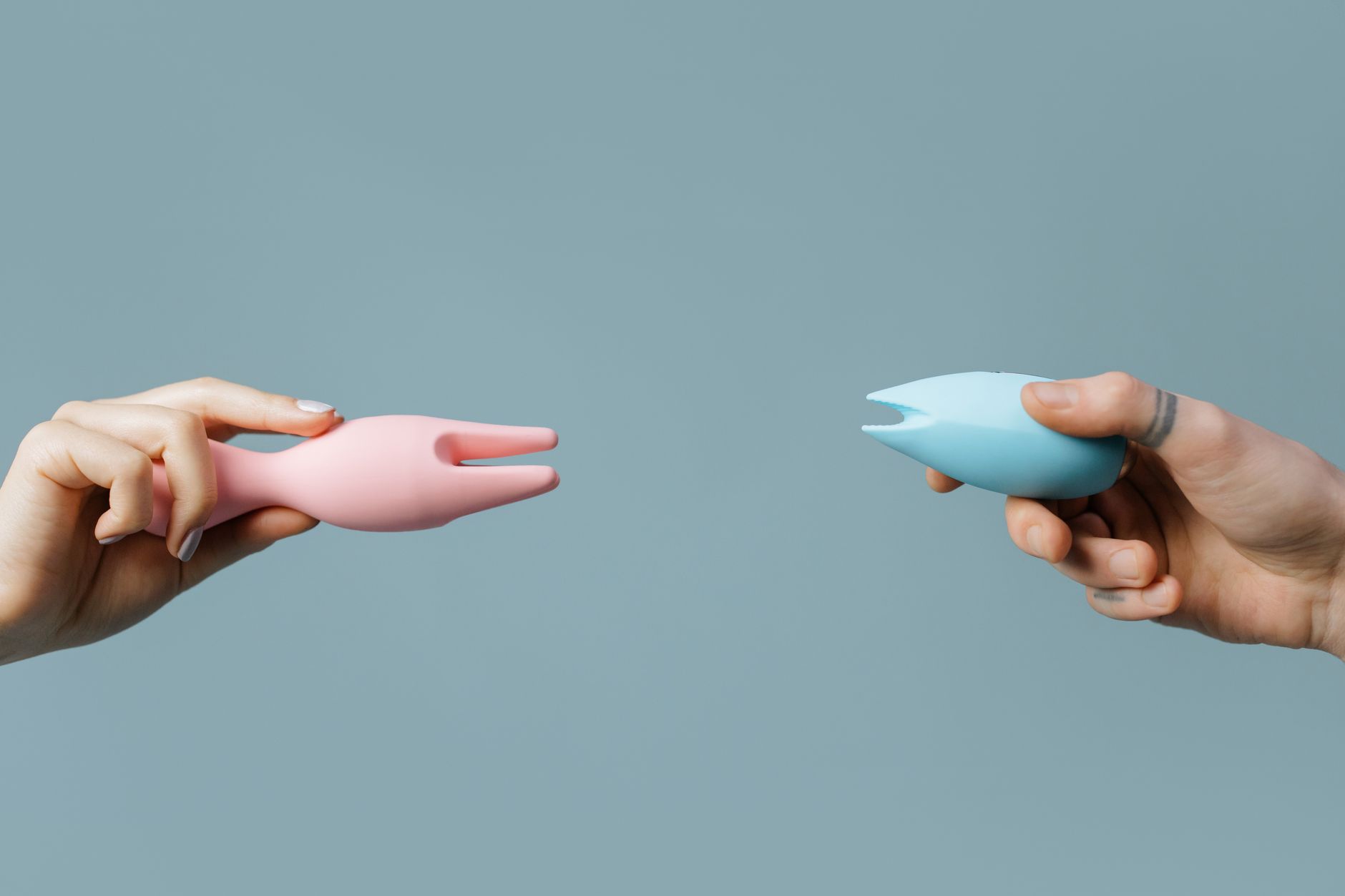
Photo by cottonbro studio on Pexels
What to do when one person wants the toy and the other feels threatened
Let's get real. Sometimes the resistance isn't about logistics. It's about meaning. "If you use a vibrator, does that mean I'm not enough?" is the question underneath a lot of pushback.
Here's what I tell couples in this situation:
A vibrator is not a replacement. It's a collaborator. Your partner's hands, mouth, presence, and attention are irreplaceable. The vibrator is handling one specific job: delivering consistent stimulation to sensitive nerve endings. Your partner is handling everything else.
Maybe sit with this together: "What would change if you used this toy and I was totally here with you? Not performing. Just... present. Curious about what happens in your body." Because that's actually the shift. Not adding a tool. Adding actual presence and permission.
I've seen this work over and over. The moment the partner who was self-conscious about the toy realizes their partner is genuinely enjoying it, genuinely interested in their pleasure, the threat evaporates. Because the real hunger was never about the vibrator. It was about being wanted.
When intensity preferences shift mid-encounter
Pleasure isn't static. Your partner might arrive wanting gentleness and halfway through need something stronger. Or vice versa.
This is where the graduated intensity range on Lemon vibrators actually saves your whole interaction. You don't have to stop, renegotiate, swap tools, apologize, or make it weird. You just... adjust.
Know the patterns your partner loves at different points in arousal. Build that into your regular practice. "When you're close, I turn it up to pattern 5." "During foreplay, we stay in pattern 2." It becomes a rhythm you both know, like a song you've learned together.
The conversation about frequency and fairness
Here's a tension that comes up often: One person wants to use Lemon vibrators regularly. The other sees them as occasional. Or one partner wants partnered play and the other wants solo time with toys.
Frequency mismatches are just preference mismatches wearing a different hat. They're also completely solvable.
Ask: "How often would feel good to you?" Listen to the real answer, not the diplomatic one. Then problem-solve like you're on the same team. Maybe one person uses the toy solo three times a week and partnered once a week. Maybe you alternate who chooses the activity. Maybe one person leads the initiative and the other participates when asked.
There is no "right" frequency. There's just the frequency that lets both people feel taken care of.
What actually heals the mismatch
It's not the toy. It's the communication underneath the toy choice.
When you can say out loud what you want, hear what your partner wants without taking it personally, and problem-solve together, the physical mechanics become secondary. The vibrator is just the place where a deeper conversation happened.
I've seen Lemon vibrators help couples have that conversation because they're not intimidating. They're playful. They're built well. And they work across a wide range of preferences, which means nobody has to choose between their pleasure and their partner's comfort.
Your preferences are not a problem. They're information. And your partner's different preferences are not a threat. They're also just information. The health of your relationship isn't measured by how often you want the same thing at the same intensity. It's measured by how honestly you can tell each other what you actually want and how creatively you problem-solve together.
FAQ: Questions people actually ask about mismatched preferences
What if my partner refuses to talk about pleasure preferences at all?
That's not a vibrator problem. That's a communication problem that probably shows up in other areas of your relationship too. Consider working with a couples therapist who specializes in intimacy. Sometimes a neutral third party makes it safer to start. You deserve a partner who's willing to engage with this conversation, even if it feels awkward at first.
Is it normal to have completely opposite preferences?
Completely? Not usually. But having some preferences that require different approaches? Absolutely normal. Most couples have at least one area where they'd naturally move differently if left alone. That doesn't mean you're incompatible. It means you get to be creative.
Can using Lemon vibrators together create connection if we're already drifting?
A good toy can create a moment of connection. But it won't fix disconnection that lives in conversation and presence. If you're drifting, the vibrator might actually highlight the drift. Use it alongside real work, not as a substitute for it. A good couples therapist is worth more than a good vibrator when the gap is emotional, not just physical.
What if my partner feels insecure about the intensity I need?
Name it directly: "Your body is not responsible for matching my pleasure needs. Your presence is what makes this work. The vibrator is just delivering what my nervous system needs to feel good." Then show your partner how much you enjoy them being there while you're using it. Insecurity often comes from invisibility. Make them visible again.
How do I know if a preference difference is actually incompatibility?
It's not. Incompatibility is when someone refuses to engage with your preferences, dismisses them as wrong, or makes you feel ashamed for wanting something different. Preference differences, even big ones, are just information. They become incompatibility only when someone won't listen.
Should we buy multiple Lemon vibrators if we have different preferences?
Not necessarily. The Lem is genuinely versatile across patterns and intensities. Start with one and learn how to use it together. You might find you don't actually need different toys, just different settings and communication. If you do eventually want separate ones for simultaneous play, that's a luxury, not a requirement.
One more honest thing
The couples who build real intimacy aren't the ones who want the same things naturally. They're the ones brave enough to name what they actually want, listen without judgment, and get curious about solutions. Lemon vibrators can help with that. But the real work is the conversation.
If you're stuck on what that conversation should sound like, reach out. We're here to help navigate this stuff.
Want to explore this further? Learn more about how Lemon vibrators help rebuild intimacy after relationship gaps and discover positioning strategies for partnered pleasure.